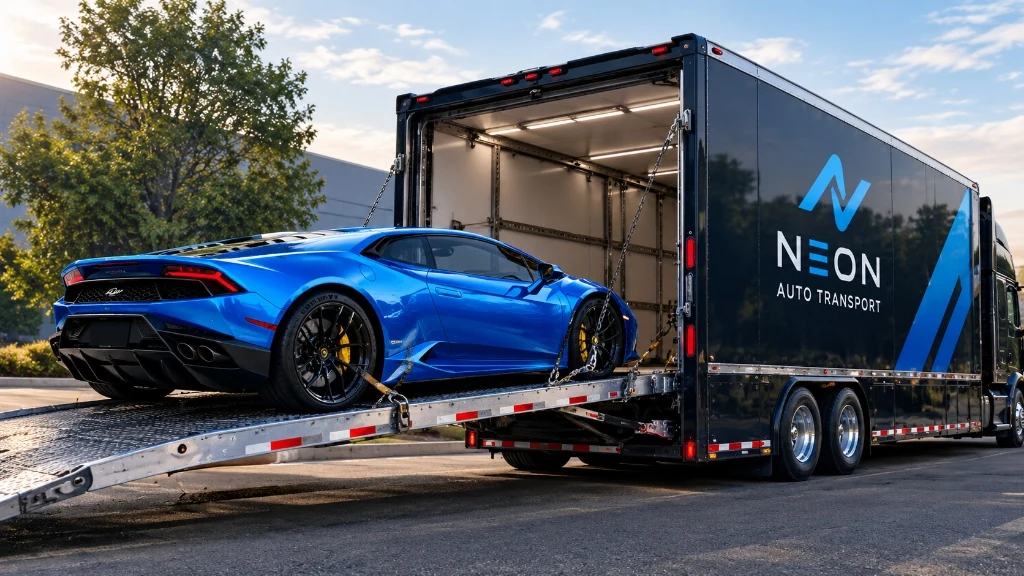
Enclosed auto transport is the gold standard for shipping high-value, irreplaceable, and low-clearance vehicles across the United States. Unlike open carriers, enclosed trailers fully protect your vehicle from weather, road debris, salt spray, dust, and UV exposure during the entire journey.
Every vehicle that demands more than just safe arrival — show cars, freshly restored classics, six-figure exotics, and low-clearance supercars — ships enclosed. Neon Auto Transport connects you with FMCSA-licensed enclosed carriers with zero upfront deposit, $500,000 cargo insurance, and a locked-in price guarantee.
What Is Enclosed Auto Transport?
Enclosed auto transport ships your vehicle inside a fully covered trailer — completely sealed from outside elements. Also known as covered car transport, closed car shipping, or enclosed car hauling, this method ensures your vehicle travels in a fully protected environment from pickup to delivery. Where open carriers expose vehicles to weather, dust, and road debris, enclosed trailers eliminate road hazards, use soft-tie restraints that protect suspension and paintwork, and feature hydraulic lift gates for low-clearance vehicles.
Enclosed trailers make up roughly 10% of the auto transport carrier fleet, which means availability is more limited than open transport — but for vehicles where condition is non-negotiable, the premium is worth every dollar.
Enclosed Auto Transport Cost — 2026 Pricing Guide
Enclosed carrier transport for a 1,500-mile shipment typically ranges from $1,400 to $1,700, although high-end or oversized vehicles may cost more. For a side-by-side breakdown of costs, vehicle safety, and carrier speeds, see our guide to open vs enclosed auto transport. Here is the full breakdown by distance:
| Distance | Typical Route | Enclosed Cost | Open Cost | Premium |
|---|---|---|---|---|
| Under 500 miles | VA to FL, NY to OH | $900 – $1,200 | $550 – $750 | ~40% more |
| 500–1,000 miles | TX to FL, IL to GA | $1,100 – $1,500 | $700 – $950 | ~40% more |
| 1,000–1,500 miles | CA to TX, NY to FL | $1,400 – $1,900 | $900 – $1,200 | ~45% more |
| 1,500–2,000 miles | CA to IL, TX to NY | $1,700 – $2,300 | $1,050 – $1,400 | ~50% more |
| 2,000+ miles | CA to NY, FL to WA | $2,000 – $2,800 | $1,200 – $1,700 | ~55% more |
2026 market rates for a standard luxury vehicle. Exotic or oversized vehicles may cost more. Get an instant quote for your exact vehicle and route.
- Cost per mile: Enclosed car transport costs between $1.00 and $2.50 per mile depending on distance and vehicle type. Longer routes cost less per mile. Short regional routes under 300 miles are the most expensive on a per-mile basis.
What drives the premium over open transport:
Enclosed transport typically costs 30–60% more than open shipping due to three structural reasons: fewer carriers in the fleet, lower vehicle capacity per trailer (2–6 vehicles vs. 8–10), and higher insurance requirements per shipment.
Enclosed Auto Transport Near Me — Cost by City
Enclosed auto transport demand concentrates heavily around major metropolitan freight hubs where exotic dealerships, private collectors, and seasonal relocations require specialized carrier coverage. When searching for enclosed car transport near me, these primary launch metros provide the highest density of vetted soft-sided and hard-sided trailers operating bidirectional nationwide routes:
| Metro | Enclosed Price (typical range) | Transit Time | Popular Enclosed Routes |
|---|---|---|---|
| Los Angeles, CA | $1,100 – $1,900 | 3 – 7 days | LA to Phoenix, LA to Seattle, LA to Denver |
| San Francisco / Bay Area, CA | $1,200 – $2,000 | 4 – 8 days | Bay Area to Portland, Bay Area to Las Vegas, Bay Area to Phoenix |
| New York City / Tri-State | $1,100 – $1,900 | 3 – 7 days | NYC to Miami, NYC to Chicago, NYC to Atlanta |
| Miami / South Florida | $1,200 – $2,000 | 4 – 8 days | Miami to NYC, Miami to Chicago, Miami to Washington DC |
Enclosed shipping is the standard across these major metro corridors due to high vehicle values, salt-belt winter departures, and steady auto auction car shipping and show-vehicle traffic. Whether you need single-car transport out of Southern California or multistate transit from the Northeast, our nationwide network delivers guaranteed pricing with zero upfront deposit.
Types of Enclosed Auto Transport Trailers
Not all enclosed carriers are identical. The trailer type significantly affects your pricing, pickup availability, and level of protection:
Soft-Sided Enclosed Trailers
The most common enclosed trailer type. Heavy-duty vinyl curtains wrap the trailer on all sides, protecting from weather, dust, and road debris. Lighter than hard-sided trailers, making them more fuel-efficient and more widely available. Best for most luxury and classic cars at a moderate premium over open transport. Ideal for vehicles valued $80,000–$250,000.
Hard-Sided Enclosed Trailers
Fully rigid aluminum or steel walls on all sides. Hard-sided trailers provide a rigid barrier against the outside world and are the most secure option, preferred for high-stakes deliveries. Often equipped with air-ride suspension for the smoothest possible transit. Best for museum-quality classics, seven-figure exotics, and vehicles where any vibration is a concern.
Single-Car Enclosed Trailers
Single-car enclosed trailers carry one vehicle, usually with a fully padded interior and hydraulic lift — used for million-dollar exotics and irreplaceable classics where any contact with another vehicle is unacceptable. Most expensive option but provides the highest level of individual attention and care.
Air-Ride Suspension Trailers
A feature available on select hard-sided and soft-sided carriers. Air-ride suspension absorbs road vibrations more effectively than standard spring suspension — critical for restored vehicles with delicate mechanical components or original paint. Ask specifically for air-ride when booking if condition is paramount.
Hydraulic Lift Gate Trailers
For owners of exotic cars with low ground clearance, a lift gate is mandatory. It allows the car to be loaded perfectly level, eliminating the risk of scraping the undercarriage on a traditional ramp. Any vehicle with ground clearance under 4 inches should request a lift gate equipped carrier at booking.
Which Vehicles Need Enclosed Auto Transport?
Always ship enclosed:
- Exotic and supercar brands — see our specialized luxury car shipping services for Ferrari, Lamborghini, Bugatti, McLaren, Porsche 911 GT3/RS, and Koenigsegg
- Classic and vintage vehicles — pre-1980 American muscle, European classics, original unrestored vehicles
- Recently restored show cars — any vehicle where paint or mechanical originality is critical
- Low-clearance vehicles — ground clearance under 4 inches requires lift gate equipped enclosed carrier
- Vehicles valued over $100,000 — insurance peace of mind alone justifies the premium
- Electric vehicles on certain routes — most EVs are heavier than equivalent gas vehicles due to battery weight and may exceed open trailer per-vehicle weight limits
Consider enclosed:
- Luxury daily drivers valued $80,000–$150,000 — Mercedes S-Class, BMW 7 Series, Audi A8, Lexus LS
- Any vehicle shipping through salt-belt states November–March (see salt belt section below)
- Recently painted vehicles — fresh paintwork is vulnerable to rock chips on open carriers
- Collector vehicles regardless of value — sentimental and historical value exceeds replacement cost
Open transport is fine for:
- Standard luxury vehicles under $80,000 in daily driver condition
- Any vehicle you would drive through rain without concern
- Vehicles where minor cosmetic wear is acceptable
The Salt Belt Warning — Why Winter Route Matters
This is the single most important factor most shippers never consider. Road salt is the silent threat on Northeast and Midwest open-trailer routes between November and March. Salt spray is corrosive and reaches the underbody of vehicles on open trailers — particularly bad for vehicles with steel components, classic cars with original undercoating, and aluminum-bodied luxury vehicles. The undercarriage exposure during a 1,000+ mile winter route can introduce rust patterns that take months to surface.
If you are shipping any of the following between November and April through states like Ohio, Pennsylvania, New York, Illinois, Michigan, or Massachusetts — choose enclosed (for seasonal winter moves southward, explore our dedicated snowbird car shipping services):
- Any classic vehicle with original undercoating
- Aluminum-bodied vehicles (many modern luxury cars)
- Recently restored vehicles
- Any vehicle you plan to show or sell
The enclosed premium on a winter route is functioning as corrosion insurance — not just weather protection.
Enclosed Auto Transport Insurance — What's Covered
Insurance is where enclosed transport provides its clearest financial advantage over open:
| Coverage Type | Open Transport | Enclosed Transport |
|---|---|---|
| Standard cargo coverage | Up to $250,000 | Up to $500,000 |
| Per-vehicle coverage | Shared across 8–10 vehicles | Dedicated per vehicle |
| Weather damage | Standard | Premium |
| COI provided before dispatch | ✅ Yes | ✅ Yes |
Enclosed carriers typically carry $250,000 to $500,000+ per shipment. With only 2–6 vehicles on board, that means $40,000 to $500,000 of coverage per vehicle — appropriate for the luxury, classic, and exotic cars enclosed trailers usually carry.
Your right as a shipper: Before any vehicle is loaded, you are entitled to request the carrier's Certificate of Insurance. Neon provides this automatically before dispatch on every enclosed shipment. If any broker or carrier refuses to provide a COI, treat it as a red flag and do not proceed.
How to Prepare Your Vehicle for Enclosed Transport
Enclosed transport customers typically have higher-value vehicles. These preparation steps apply specifically to them:
Before pickup:
- Detail and photograph the vehicle extensively — every panel, wheel, undercarriage, and interior. Use timestamps.
- Document all pre-existing imperfections in writing on the Bill of Lading. Be specific — "hairline scratch, driver door, 3 inches above handle"
- Disable aftermarket alarm systems and provide the disarm code to your driver
- Remove all personal items, floor mats, and loose accessories
- Note any mechanical sensitivities — stiff clutch, sensitive brakes, low-clearance front lip
- Ensure the gas tank is at 1/4 full
- For low-clearance vehicles — confirm the carrier has a hydraulic lift gate before the booking is finalized
- For vehicles with aftermarket exhausts — notify the carrier so they can plan loading positioning
- Retract or remove aftermarket spoilers if they affect trailer clearance
- Have your title or registration available at pickup for identity verification
At pickup:
Walk the vehicle with the driver before loading. Review and sign the Bill of Lading together — every noted imperfection should be recorded. Keep your copy. This is your legal protection if any new damage occurs.
At delivery:
Inspect in daylight before signing the delivery BOL. Check paint under direct light. Verify all panels, glass, and wheels. Any new damage must be noted on the BOL before signing and photographed immediately. Do not sign a clean BOL if you have any concerns.
Why Choose Neon for Enclosed Auto Transport?
No upfront deposit — not even for enclosed.
Most competitors require $200–$500 deposits to book enclosed transport. Neon charges nothing until a vetted carrier is assigned. For a six-figure Ferrari, you should not be handing money to a broker before your vehicle is actively dispatched.
Direct driver contact.
You receive your enclosed carrier driver's direct phone number. For irreplaceable vehicles, being able to call or text the driver directly — not a call center — is not optional. It's a requirement. We build it into every booking.
$500,000 cargo insurance on every enclosed shipment.
Every enclosed carrier in our network carries the minimum FMCSA-required coverage plus additional cargo insurance up to $500,000. You receive a Certificate of Insurance before your vehicle moves. No exceptions.
Price-lock guarantee.
The enclosed transport quote you receive is the final price. No fuel surcharges added at delivery. No "market rate adjustment" after booking. Your price is locked.
Carrier vetting for enclosed specifically.
Not every carrier that runs open transport is qualified for enclosed. Our network vets enclosed carriers separately — confirmed FMCSA authority, valid insurance, clean safety record, appropriate equipment (lift gate, air-ride, soft-tie restraints), and experience with high-value vehicles.
10,000+ carrier network.
A large network means we find the right enclosed carrier for your specific vehicle — not just the nearest available truck. For a 1930s classic, we find a carrier with padded interiors. For a McLaren 720S, we find a carrier with a hydraulic lift gate. The right carrier for the right vehicle.
Enclosed vs. Open Auto Transport — Complete Comparison
| Feature | Enclosed Transport | Open Transport |
|---|---|---|
| Starting cost | $900 | $550 |
| Cost per mile | $1.00 – $2.50 | $0.70 – $0.90 |
| Vehicle exposure | Fully protected | Open to elements |
| Weather protection | Complete | None |
| Salt spray protection | Complete | None |
| Insurance coverage | Up to $500,000 | Up to $250,000 |
| Carrier availability | Limited | Very high |
| Vehicles per trailer | 2–6 | 8–10 |
| Pickup window | 3–7 days typical | 1–3 days typical |
| Best for | Luxury, classic, exotic | Standard vehicles |
| Lift gate available | Yes | Rarely |
| Air-ride suspension | Available | Rarely |
| Soft-tie restraints | Standard | Not always |
Related Services
- Open Auto Transport — Most Affordable Option
- Luxury Car Shipping Services
- Expedited Auto Transport
- Door-to-Door Car Shipping
- Most Popular Route: California to Texas
- California to Texas Enclosed Car Shipping Guide
- Full Auto Transport FAQ
- Local to Woodbridge VA? View Local Services
- Local to Arlington VA? View Arlington Services
Related Enclosed Routes
Looking for dedicated lane details, transit schedules, and corridor pricing? Browse our high-volume enclosed routes:
- → enclosed car shipping California to Texas (I-10 / I-40 southern corridor)
- → New York to Florida Car Shipping (I-95 Atlantic snowbird corridor)
- → California to Florida Car Shipping (Coast-to-coast enclosed transport)

Enclosed Auto Transport FAQs
What is enclosed auto transport?
Enclosed auto transport ships your vehicle inside a fully covered trailer, protecting it from weather, road debris, dust, and salt spray during transit. It is the premium method used for luxury, classic, exotic, and high-value vehicles that require maximum protection. Enclosed trailers carry 2–6 vehicles and provide cargo insurance coverage up to $500,000.
How much does enclosed auto transport cost?
Enclosed auto transport costs between $900 and $2,800 depending on the distance, vehicle size, and route. Short regional routes under 500 miles typically cost $900–$1,200. Cross-country shipments over 2,000 miles average $2,000–$2,800. Enclosed transport costs 30–60% more than open transport due to limited carrier availability and higher per-vehicle insurance requirements.
Is enclosed auto transport worth it?
Yes, for the right vehicle. If your car is valued over $80,000, has low ground clearance, is a classic or restored vehicle, or is shipping through salt-belt states in winter, enclosed transport is worth every dollar of the premium. The cost difference between open and enclosed on a cross-country shipment is typically $600–$1,000 — a fraction of the cost of repairing paint damage, rust, or suspension damage on a high-value vehicle.
What is the difference between soft-sided and hard-sided enclosed trailers?
Soft-sided trailers use heavy-duty vinyl curtains to protect vehicles — lighter, more fuel-efficient, and more widely available. Hard-sided trailers use rigid aluminum or steel walls — the highest level of protection, often with air-ride suspension, preferred for seven-figure exotics and museum-quality classics. For most luxury vehicles, soft-sided enclosed transport is adequate. For irreplaceable classics, hard-sided is recommended.
Do I need to pay a deposit for enclosed transport?
Not with Neon Auto Transport. We charge no upfront deposit for any shipment — including enclosed. You pay nothing until a carrier is assigned. Most competitors charge $200–$500 just to book enclosed transport. We don't.
How long does enclosed auto transport take?
Transit time depends on distance. Regional routes under 500 miles take 1–3 days. Mid-range routes of 500–1,500 miles take 3–6 days. Cross-country routes over 2,000 miles take 6–10 days. Enclosed carriers may have slightly longer pickup windows than open — plan for 3–7 days from booking to pickup, especially in rural areas or during peak season.
Can you ship a non-running vehicle in an enclosed trailer?
Yes. Enclosed carriers can transport inoperable vehicles using winches and hydraulic lift gates. Non-running vehicles may incur an additional fee of $100–$250 depending on the equipment needed to load the vehicle safely.
What vehicles require a hydraulic lift gate for enclosed transport?
Any vehicle with ground clearance under 4 inches requires a lift gate. This includes most modern supercars (Lamborghini Huracán, Ferrari 488, McLaren 720S, Porsche 911 GT3), extensively lowered vehicles, and vehicles with aftermarket front splitters or lips that would contact a standard loading ramp. Always notify us of your vehicle's ground clearance at booking so we confirm lift gate availability before dispatch.
What Our Customers Say
Authentic 5.0-star reviews from verified customers on Google Maps.
"Neon Auto Transport shipped my F-150 across the country. Outstanding communication from pickup to final delivery!"
"Fast quote, transparent pricing, zero hidden charges. Will definitely use Neon for all future relocations."
"They were all over it. Great price. On time. Wouldn't want to use anybody else. Mike."
Shazil Ali serves as Director of Operations at Neon Auto Transport, overseeing vehicle shipping operations, carrier coordination, dispatch management, logistics workflows, and customer transportation solutions nationwide. He reviews transportation guides, route pages, service content, and educational resources to ensure accuracy, transparency, and alignment with current auto transport industry standards.